Is Your Phone Actually Listening to Your Calls?
You mentioned something to a friend yesterday. Didn't search it. Didn't type it anywhere. Just said it out loud during a conversation. Today the ad showed up. You're not imagining it. And you're not alone.
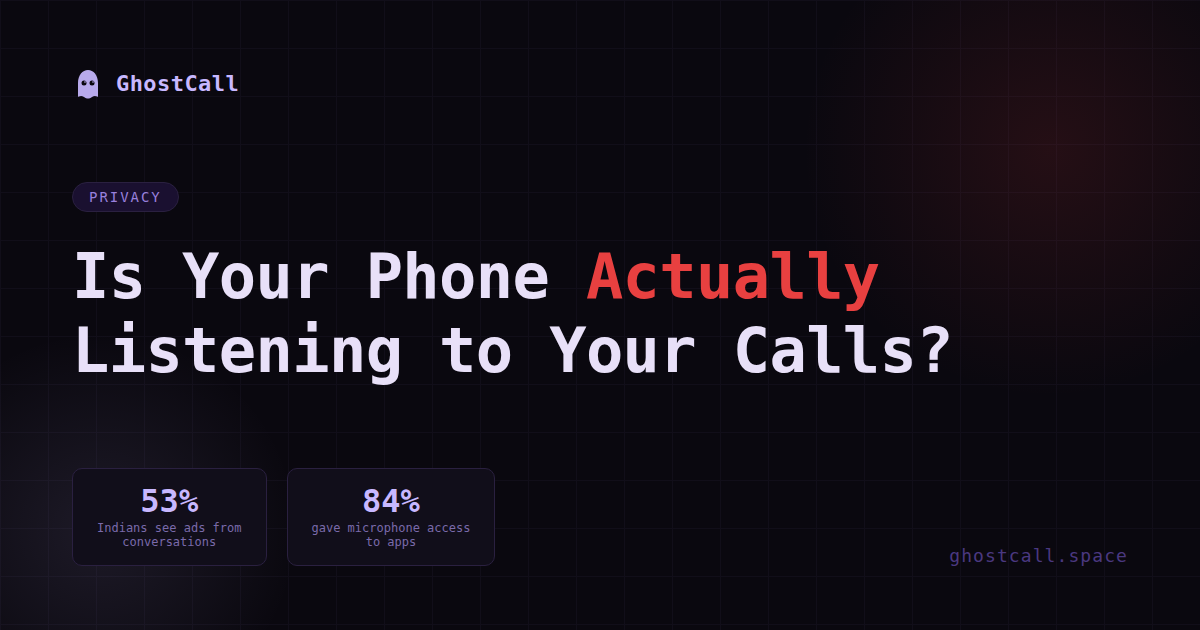
The thing half of India has noticed
Half. That's not a fringe concern. That's most people who use a smartphone in India having the same unsettling experience and not knowing what to make of it.
The honest answer is — we don't fully know
This is the part that's genuinely frustrating to write because there's no clean definitive answer.
What we know is this. Many apps ask for microphone access. Gaming apps, social media apps, calling apps. And in many cases users are not told exactly why their microphone is being accessed or where that data is going.
What we also know is that the major platforms — Meta, Google — officially deny using microphone audio for ad targeting. They say it's coincidence. Behavioural prediction. You searched something related two weeks ago and forgot. Your friend searched it and you share a network. The algorithm is just that good at predicting what you'll want next.
Maybe that's true. The algorithm genuinely is frighteningly good. But it doesn't fully explain the feeling. And it doesn't explain why it keeps happening to so many people in such specific ways.
What could actually be happening
Apps with microphone access are doing something with audio they're not being transparent about. Not necessarily recording full conversations. Could be keyword detection. Could be ambient sound analysis.
A combination of both. The algorithm handles most of it. A small number of apps do something shadier. The result feels universal because the algorithm is so pervasive.
None of these is comforting.
The microphone permission problem
You gave that permission once, probably years ago, when you first installed the app. You clicked Allow because you wanted the feature to work. You haven't thought about it since. But that permission is still sitting there. Active. Every time the app runs in the background.
Go check your phone right now. Settings → Apps → Permissions → Microphone. Count how many apps have access. Most people are surprised by the number.
What about calls specifically
Regular phone calls go through your telecom carrier — Jio, Airtel, Vi. Your carrier knows who you called, when, for how long, and where you were when you called.
WhatsApp calls are end-to-end encrypted. Meta cannot technically listen to the audio. But Meta knows you made a call, who you called, how long it lasted, your location when you called, and about a hundred other metadata points. Metadata about a call can reveal a lot without ever touching the audio.
can see anything, not even metadata — are peer-to-peer calls.
Where the audio travels directly between two devices
and never touches a server at all.
Why peer-to-peer calls are different
When two browsers connect directly to each other — no server in the middle, audio going straight from device to device — there's nothing to intercept. No audio file sitting on a server. No metadata being logged by a platform. Nothing passing through any infrastructure that could be analysed, stored, or sold.
This is the technology called WebRTC. Google Meet, Discord, and WhatsApp Web all use it under the hood. The difference is those platforms still route your call setup through their servers, still log your metadata, still know you made a call. The audio might be encrypted. Everything around the audio is still visible to them.
A purely peer-to-peer call with no accounts, no platform, no metadata — that's a different category entirely.
GhostCall works this way
When you make a call on GhostCall, the audio goes directly from your browser to the other person's browser. GhostCall's servers handle the initial connection — the handshake that helps the two browsers find each other — and then step out completely. The audio itself never touches the servers.
GhostCall doesn't know who you are. Doesn't know who you called. Doesn't log your number because you never gave one. There's no account so there's no profile to attach the call to.
When the call ends the room is destroyed. The link stops working. There's no record anywhere that the call happened. This isn't a privacy claim. It's how the technology works. There's nothing to listen to because there's nothing going through any server to be listened to.
So is your phone listening to your calls
Probably not your calls specifically. The audio is more protected than most people think.
But your phone is doing a lot of other things around your calls — tracking who you called, when, where, how often — that add up to a surprisingly complete picture of your life without ever needing to hear a word you said.
The safest call is one where none of that metadata exists either. No account. No number. No platform logging the interaction. That's harder to find than it should be in 2026. But it exists.
More from GhostCall Blog
→ So what actually is GhostCall? → Who Is GhostCall Actually For? → How to Do a Client Call Without Giving Your Personal NumberNo account. No number. Nothing logged. Just a call that vanishes when you hang up.
Try GhostCall Free →